A Short History of the Bridge
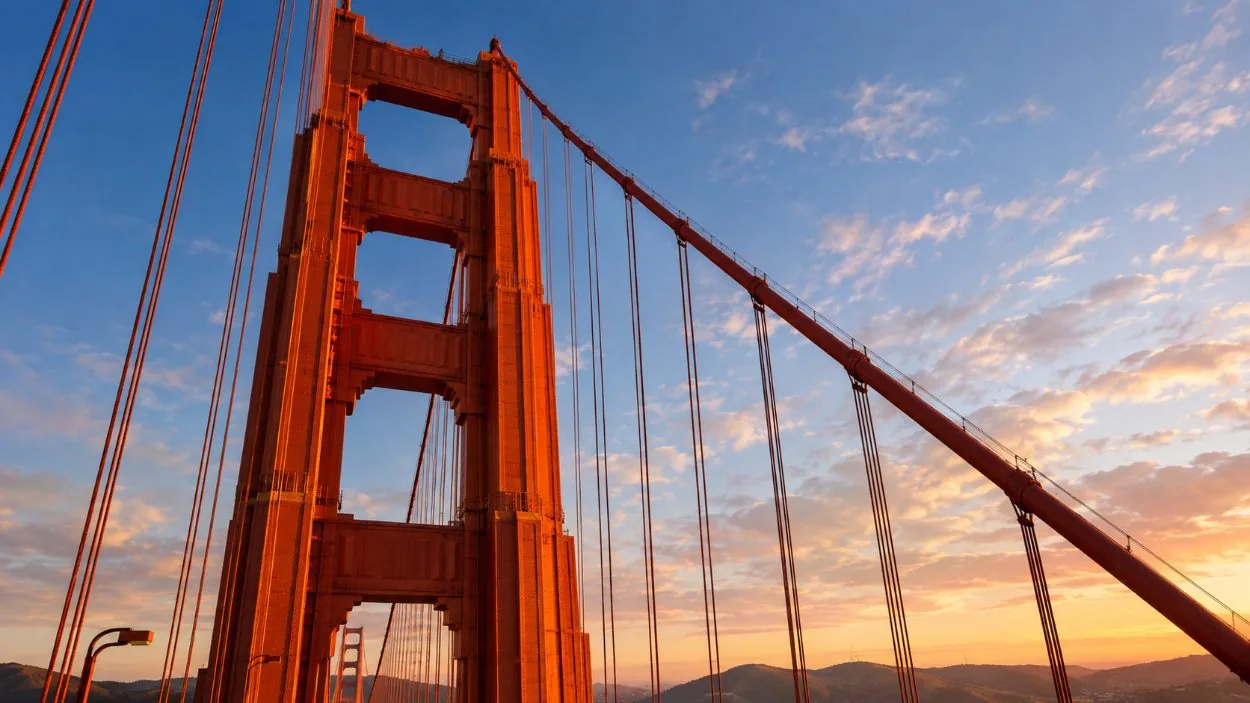
1933 to 1937
Work began on 5 January 1933 at the height of the Depression. Strauss was chief engineer and the public face; Charles Ellis did much of the structural design, Leon Moisseiff was consulting engineer, and Irving Morrow, the consulting architect, gave the towers their Art Deco details and picked the colour, International Orange. The job finished on 19 April 1937, ahead of schedule and under budget. The figures are on the facts page.
The safety net and the Halfway to Hell Club
A safety net was hung under the deck as it was built. Nineteen men fell into it and lived; they called themselves the Halfway to Hell Club. On 17 February 1937 a scaffold fell through the net and ten men died. Eleven workers died on the job in all. I mention this on the sidewalk when people ask why the net matters.
Pedestrian Day and the telegraph key
On 27 May 1937 the bridge opened to people on foot, and about 200,000 of them walked or roller-skated across before a single car had crossed. The next day, 28 May, President Roosevelt pressed a telegraph key in the White House and the road opened. Roller skates have since been banned on the sidewalk, which strikes me as a loss.
Wind closures
The deck is built to move, up to 27.7 feet sideways at mid-span, and three times the District has judged the wind too much and closed it to traffic: in 1951, in 1982 and in 1983. If you walk it on a gusty afternoon you will feel a little of why. The what-to-wear page is the practical side of that.
The fiftieth birthday, 1987
On Sunday 24 May 1987 the bridge was closed to cars and opened to walkers for its fiftieth anniversary. Somewhere between 750,000 and a million people turned up, far more than planned. The crowd was so dense that the deck’s arch flattened out under the load. The bridge was not damaged, but the engineers have not repeated the experiment.
Loma Prieta and the retrofit
The Loma Prieta earthquake of 17 October 1989 had its epicentre about 60 miles south. The bridge showed no damage, but the quake started the seismic-retrofit programme that is still under way.
The net, 2024
A steel suicide-deterrent net below the deck was completed in January 2024. During the works the east sidewalk sometimes closed an hour early on weeknights. From the bay cruise, passing underneath, you can see the net clearly against the underside of the deck; from the sidewalk it is a grey line below the railing.
The free City Guides walk on Wednesdays and Saturdays covers this history at the Strauss statue and ends at the south tower. It is the best hour and a half on the bridge that costs nothing.
Frequently asked questions
Who built the Golden Gate Bridge?
Joseph Strauss was chief engineer, with Charles Ellis on structural design, Leon Moisseiff as consulting engineer and Irving Morrow as architect. The facts page has the dimensions they produced.
How many people died building it?
Eleven. Ten died on 17 February 1937 when a scaffold fell through the safety net; nineteen others were saved by that net. The free City Guides tour on the things-to-do page covers this.
Has the bridge ever been closed?
To traffic for high wind three times, in 1951, 1982 and 1983, and to cars for the 1987 anniversary walk. The sidewalks close nightly; see the walking page for hours.
Why is it called the Golden Gate?
After the strait, named by John C. Frémont in 1846. The colour is International Orange. Full answer on the name page.